Showing posts with label theme. Show all posts

Monday, September 7, 2009

Business planning... or Marketing Campaigns


For your entrepreneur/innovation/inventor project you do not have to do a business plan. However, you do need to prepare a product, having done market research. You need to design and refine a product that suits a need you have discovered. You do not need to actually construct a completely functional prototype if it's too tricky, but actual products made to a high standard would be very cool! If you don't make an actual model, you do need some form of high quality visual presentation. Use your IT skills whever possible. You will be presenting your "sales pitch" at a trade fair in the gym in week 10. You will probably have no more than a desk space to work with. It will need to be made to look professional. Again, as with all posts, we will clarify this in class.
In class we will continue to investigate the powers of advertising as part of our integrated learning through reading and other language lessons. This will improve your ability to create an irresistable marketing plan - bold statements, catchy phrases, effective colours, snazzy jingles!
As producers of goods for sale you need to be aware of the consumer guarantees act, consumer rights and the responsibilities of producers and advertisers. [We will go over all terms used here in class.]
See below some websites with information relating to these topics:

http://www.consumeraffairs.govt.nz/consumerinfo/cga/

http://www.consumer.org.nz/reports/consumer-guarantees-act

The Advertising Standards Authority

Now Create Your Own AD! Click here to begin...

Monday, August 24, 2009

Term 3 Mega-Project!


[boot is made of organic hemp and recycled tyres]

As discussed in class, you need to come up with an innovative, entrepreneurial or inventive idea that you can design, develop and market to a target audience. In class you will have time to work on the project. You need to work alone. [In special cases I will allow people to work together - e.g. the worm farm project is a group effort.]
You need to:
1. Have an idea for something that needs improving, re-designing, or inventing from scratch.
  • Consider something that annoys you and that you can think of a solution for. [Remember the story of the girl who had to stop her cat following her to school each day.
2. Start an inventors or innovators log book to record your ideas, designs, market research, discussions with others, etc. Date your entries and show the development of your thinking, including ideas that you decide against.

3. Plan, model, test, produce your prototype.

4. Test your product on an audience for feedback.

5. Evaluate the product and make any improvements required.

6. Design a marketing campaign. Try to be innovative and amazing with this - blow your audience away! Use advertising tricks [as discussed in class and on previous blog posts] to lure your audience in to wanting to buy or use your product.
  • TV ads
  • Radio ads
  • Print ads in b/w or colour
  • Internet marketing
  • Can you think of other ways to promote your product or idea?
7. Present your entire project at the Matai Team Trade Fair in Wk 10 in the Gym. Plan ahead to have access to anthing you need to make your display a success. You will need to stand at a stall of some description to "sell" your idea to passersby. Parents, teachers and other classes will be invited.

See Mr Nunn's example for a minimum requirement.

Media Literacy


What is media literacy? How does it relate to you young Woodmonstas? It may be amongst the most important areas of learning for your generation.
The following material is from the website "Dont' Buy It" ... [It's a really interesting interactive site with topics for you to reflect upon, like why bother buying designer clothes or trying to look like a super model.]


"What is Media Literacy?

Media literacy empowers people to be both critical thinkers and creative producers of an increasingly wide range of messages using image, language and sound. It is the skillful application of literacy skills to media and technology messages. As communication technologies transform society, they impact our understanding of ourselves, our communities and our diverse cultures, making media literacy an essential life skill for the 21st Century.
--Alliance for a Media Literate America

Media literacy goes beyond the idea of reading and writing. It requires media consumers to effectively analyze and evaluate the numerous media messages we encounter.

Media education can facilitate students' reflections on their media experiences and help them develop critical thinking skills. The classroom exercises proposed in this guide may support many different subject areas, including arts and language, mathematics, health and nutrition"

- http://pbskids.org/dontbuyit/

Access the site and check out the activities. It relates to our thematic learning on entrepreneurs etc because we will be advertising our innovations and inventions at our class trade fair this term.

Thursday, April 16, 2009

Sustainability in Term Two

Our Team Theme for Term Two is Sustainability. We will have to work in with what we plan as a team, but if we use an inquiry method of learning, we should be able to find questions that interest us that we can pursue in our own ways, to some degree.
Their will be key concepts and contexts that we need to understand and we need to actually achieve something real and meaningful to us, in order to make the learning worthwhile.
So, what is Sustainability? Add your own thoughts on the topic and how you would like to learn about it. If you know experts we could talk to or have really good ideas for projects we could try, say so here. Perhaps start a Sustainability blog for your project work, resource gathering, etc.

Wikipedia says:

Sustainability

From Wikipedia, the free encyclopedia


Blue Marble composite images generated by NASA in 2001 (left) and 2002 (right).

Sustainability, in a broad sense is the ability to maintain a certain process or state. It is now most frequently used in connection with biological and human systems. In an ecological context, sustainability can be defined as the ability of an ecosystem to maintain ecological processes, functions, biodiversity and productivity into the future.[1]

Sustainability has become a complex term that can be applied to almost every facet of life on Earth, particularly the many different levels of biological organization, such as; wetlands, prairies and forests[2] and is expressed in human organization concepts, such as; eco-municipalities, sustainable cities, and human activities and disciplines, such as; sustainable agriculture, sustainable architecture and renewable energy.[citation needed] Many sustainable practices are being identified as "green" initiatives.

For humans to live sustainably, the Earth's resources must be used at a rate at which they can be replenished. However, there is now clear scientific evidence that humanity is living unsustainably, and that an unprecedented collective effort is needed to return human use of natural resources to within sustainable limits.[3][4]

Since the 1980s, the idea of human sustainability has become increasingly associated with the integration of economic, social and environmental spheres. In 1989, the World Commission on Environment and Development (Brundtland Commission) articulated what has now become a widely accepted definition of sustainability: "[to meet] the needs of the present without compromising the ability of future generations to meet their own needs.”[5]

Sustainable development

From Wikipedia, the free encyclopedia
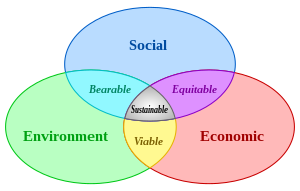

Scheme of sustainable development: at the confluence of three constituent parts.[1]

Sustainable development is a pattern of resource use that aims to meet human needs while preserving the environment so that these needs can be met not only in the present, but also for future generations to come. The term was used by the Brundtland Commission which coined what has become the most often-quoted definition of sustainable development as development that "meets the needs of the present without compromising the ability of future generations to meet their own needs."[2][3]

Sustainable development ties together concern for the carrying capacity of natural systems with the social challenges facing humanity. As early as the 1970s "sustainability" was employed to describe an economy "in equilibrium with basic ecological support systems."[4] Ecologists have pointed to the “limits of growth”[5] and presented the alternative of a “steady state economy”[6] in order to address environmental concerns.

The field of sustainable development can be conceptually broken into three constituent parts: environmental sustainability, economic sustainability and sociopolitical sustainability.